


Where is Harewood, Exactly?
Updated: Feb 20
February 11, 2026

A Study in Harewood Cartography
If you ask a longtime local where Harewood is, they'll answer without hesitation.
If you ask a map, things get complicated.
Over the last few years, many Nanaimo residents have noticed something odd: maps that once clearly labeled Harewood now split the area in two, shrink it, or replace it altogether with another name: University District. Real estate listings sometimes go further, describing Harewood as the "former" name of the area, or suggesting it's merely a nickname that locals use "affectionately".
So what gives? Did Harewood move? Disappear? Get rebranded?
When Harewood Governed Itself
To understand Harewood, you have to start before neighbourhoods were marketing terms.
Founded in the late 19th century as Five Acre lots for miners and other workers to lease and live on, Harewood grew quickly into something much more.

For much of the 20th century, Harewood was not a subsection of Nanaimo at all. It was its own civic entity: the Harewood Improvement District. Improvement Districts were responsible for roads, water, and local services in areas outside city limits. They had defined boundaries, elected trustees, and a strong sense of local autonomy.
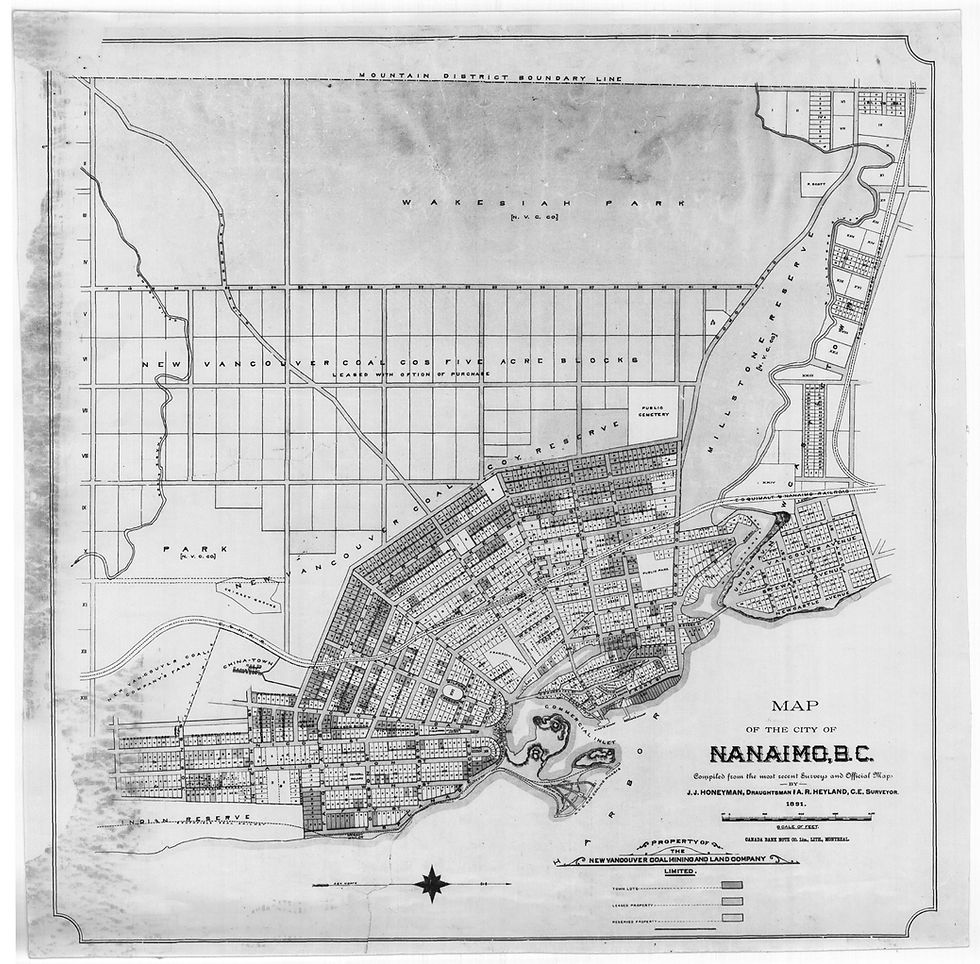
Historic maps (like the one picture below) show Harewood as a large, coherent district – comparable to places like Wellington, Extension, and Cedar. It wasn't "south Nanaimo" and it wasn't a neighbourhood. It was an independent community that was in charge of its own affairs.

That identity stuck. Schools, stores, shopping centres, sports teams, and everyday conversation all reinforced the name Harewood as a place you were from; not just where your house happened to be.
This excellent map (pictured at the top of this article) by writer and Harewood historian Nathaniel Christopher shows Harewood's official boundaries in 1973, just two years before the District was amalgamated into the City of Nanaimo.
Amalgamation in 1975 dissolved the Harewood Improvement District and absorbed its territory into the expanding city. Legally and administratively, Harewood ceased to exist as a governing body – but culturally, nothing vanished overnight. People didn't stop saying "Harewood". Businesses didn’t rebrand. The place still felt like itself.
But as Nathaniel points out, even longtime Harewood residents might disagree on exactly where they think the boundaries of Harewood are.
Harewood on Modern City Maps
Fast forward a few decades, and the City introduces formal neighbourhood planning areas. These aren't legal jurisdictions – they're tools used for land-use planning, development tracking, and public consultation.
On the City’s official neighbourhood map, Harewood still exists. It is clearly labeled and recognized as a planning area. So is the University District, a separate neighbourhood to the north of Harewood, centred around Vancouver Island University and the surrounding high-density housing.

But here's the crucial point: These neighbourhoods were drawn for planning convenience, not to preserve historic boundaries or cultural identity.
The line dividing Harewood and University District on today's map does not claim to redefine history. It simply reflects how the City currently organizes growth and development.
Officially speaking, Harewood is still there.
The Quiet Renaming
Unlike city planning maps, real estate maps are designed to sell. Over time, the term University District has expanded beyond its official boundary in listings and promotional material. In some cases, it swallows most (or all) of what locals have always called Harewood.
None of this is official policy. But repeated often enough, it changes perception.
Why? Because names carry baggage – and value.
"Harewood" has long been a working-class name, tied to coal mining, industry, and (fairly or unfairly) a rougher reputation in certain decades. The name "Scarewood" was scaring away investors.
"University District" sounds newer, cleaner, more investment-friendly. One suggests roots. The other suggests opportunity.
This isn't unique to Nanaimo. It's a familiar pattern in cities everywhere. But when it happens quietly, without discussion, it can feel like erasure.
Some local businesses have embraced the name change as well. Neighbourhood institution Harewood Mall is now called University Village Shopping Centre. Some cherished old haunts that added to the legacy – like the Harewood Arms Pub – have unfortunately closed down.

Harewood Lives On
There are still a lot of us left who love the name Harewood and don't want to see our community identity disappear.
The Harewood Neigbourhood Association is a group of community members that meets regularly to work on improvement projects and local initiatives.
New areas of commercial development – like Harewood Heights on Bruce Avenue, or the new Harewood Pet Hospital – continue to carry the namesake torch.
One of the main reasons we created this website is to make sure we don't forget the hard work of our Harewood foremothers and forefathers, who fought to make our neighbourhood the vibrant and wonderful community it is today!



Comments